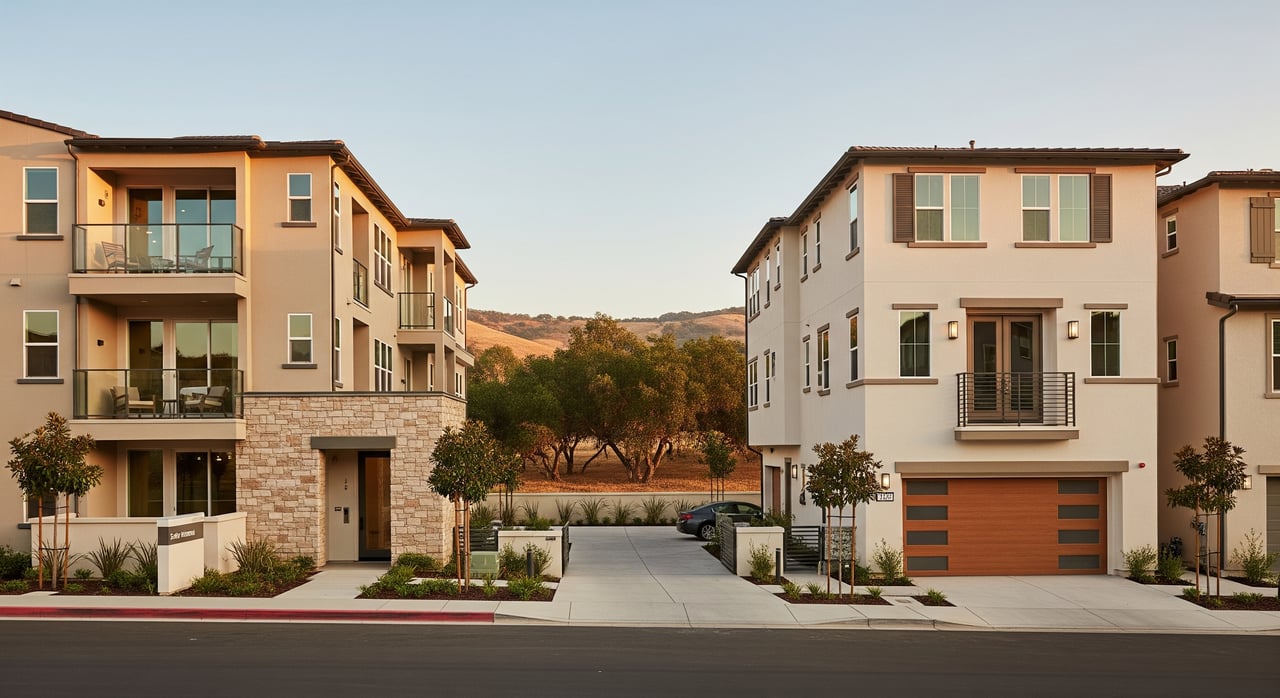
Trying to choose between a condo or a townhome in Saugus and the Newhall area? You are not alone. Early-stage buyers across Santa Clarita often ask which option fits their budget, lifestyle, and long-term plans. In this guide, you will learn the real differences in ownership, HOA responsibilities, financing and insurance must-knows, and what to watch for in local communities. Let’s dive in.
Big difference: what you own
When you buy a condo, you typically own the interior of your unit and share ownership of the land and building with other owners. The homeowners association (HOA) manages most exterior and common-area items. Your deed will often describe your unit as the “air space” inside the walls.
When you buy a townhome, ownership can be structured two ways. Some townhomes are fee simple, which means you own the home and the land it sits on, similar to a single-family home. Others are built as condo-style projects, where you own the interior but not the land, so they function a lot like condos for maintenance and governance.
In California, the Davis-Stirling Common Interest Development Act outlines how HOAs operate, from budgets to member rights. The key takeaway for you is that the community’s CC&Rs and the master insurance policy define who is responsible for what. There is no universal rule, so always verify it in writing.
Day-to-day maintenance
With condos, the HOA usually handles exterior and structural items, plus common landscaping, roofs, and shared systems. You are typically responsible for interior maintenance, finishes, and personal systems inside your unit.
With townhomes, if your title is fee simple, you may be responsible for your roof, exterior paint, yard, and driveway. If your townhome is part of a condo-style association, exterior responsibility may sit with the HOA. The CC&Rs spell out whether coverage is walls-in, walls-out, or something in between.
HOA duties and your budget
In Santa Clarita communities, HOAs commonly handle landscaping in common areas, internal streets or walkways, and shared amenities. Gated entries, pools, spas, fitness rooms, and clubhouses are managed by the association where offered. Trash service and some utilities may be included in dues, depending on the development.
For your monthly budget, focus on two things: what the fee covers and the financial health of the HOA. A well-run HOA maintains buildings and amenities, funds reserves for big-ticket items, and communicates plans clearly. A struggling HOA can lead to special assessments and rule changes that affect your costs.
Here are smart items to review:
- Budget and monthly dues, including what is and is not covered (gas, water, sewer, cable, exterior insurance).
- Reserve study and current reserve balance for roof replacement, paving, and other long-term needs.
- Delinquency rate, which can signal risk of future assessments.
- Recent or planned special assessments and capital project timelines.
- Any pending litigation that could affect insurance or costs.
- HOA master insurance details and deductibles.
Red flags to watch
- No recent reserve study or clearly underfunded reserves.
- Significant litigation involving the association.
- High delinquency rates among owners.
- New or repeated special assessments.
- Strict use restrictions that conflict with your plans.
- Insurance gaps or unclear “who covers what” between the HOA and owners.
Financing and insurance basics
Condo financing can involve project-level reviews for certain loan types. If you plan to use FHA or VA, you will need to confirm the project’s approval status. Lenders may also look at owner-occupancy ratios, investor concentration, insurance coverage, and any litigation before approving a loan.
Fee simple townhomes are often underwritten more like single-family homes, with fewer project-level hurdles. If a townhome is legally a condo-style development, lenders will review it similarly to a condo. Ask your lender early about the specific property to avoid surprises.
For insurance, condo owners generally carry an HO-6 policy that covers the interior, improvements, personal property, loss of use, and personal liability. The HOA’s master policy usually covers common areas and may cover the building shell. If the master policy has a high deductible, owners could face an assessment after a claim.
Townhome owners with fee simple ownership often need a homeowners policy, such as HO-3, that covers the structure and exterior. If the association’s master policy covers exteriors for a condo-style townhome, your needs may look closer to an HO-6. In all cases, confirm coverage with the HOA documents and your insurance agent.
Wildfire and earthquake are material risks in the Santa Clarita Valley. Standard policies do not include earthquake coverage, and wildfire-related coverage can vary by carrier and location. Budget for separate policies or endorsements as needed.
Resale factors in SCV
Condos can be attractive to first-time buyers and tend to perform well in price-sensitive phases of the market. Resale can be affected by HOA reserves, litigation, and rental rules. Townhomes appeal to buyers who want more space and a feel closer to a single-family home, and fee simple ownership can widen the buyer pool.
Market conditions change seasonally and by neighborhood. Focus on project-level health, parking and storage options, commute needs, and how the rules align with your lifestyle. These factors will matter as much as price per square foot when you go to sell.
Lifestyle trade-offs in Saugus and Newhall
Space and privacy
Condos typically offer smaller footprints with shared walls and limited outdoor space, which can be ideal if you prefer low maintenance. Townhomes often provide multiple levels, a private garage, and a small patio or yard, giving you more storage and separation.
Amenities and parking
Many condo communities include shared amenities, like pools and gyms, which the HOA maintains. Townhome communities may or may not offer the same amenity set. Parking varies widely, so confirm your assigned spaces, garage configuration, and guest parking rules before you write an offer.
Commute and location
Saugus and Newhall provide access to SR-14 and I-5, with Metrolink access in the broader Newhall and Valencia area. If you commute to Los Angeles, factor in peak-hour drive times and train schedules. Also look at local traffic patterns and street parking availability around your complex.
Noise, neighbors, and rules
Shared walls exist in both condos and townhomes. Rules in some condo communities can be stricter around noise, decor, and use of common spaces. Review CC&Rs for policies on exterior changes, satellite dishes, holiday decor, and architectural approvals.
Environmental risks
Some Saugus neighborhoods near foothills face brush and wildfire exposure that can affect insurability and mitigation requirements. Earthquake risk applies across Los Angeles County. Review defensible space measures and consider separate earthquake insurance.
Your due diligence checklist
Go in with eyes open by requesting documents early and asking focused questions. These lists will help you compare options apples to apples.
Documents to request
- CC&Rs, bylaws, and rules and regulations.
- Current budget and recent financials.
- Most recent reserve study and funding policy.
- Board meeting minutes for the past 12 to 24 months.
- Master insurance policy declarations and summary.
- Notices on special assessments or capital projects.
- Litigation disclosures and any legal correspondence.
- Delinquency report or percentage.
- Rental and occupancy rules, including short-term rentals.
- Management agreement and contact details.
- Architectural guidelines and alteration procedures.
Questions to ask
- What exactly does the monthly HOA fee cover?
- Are any special assessments or major projects planned in the next 1 to 5 years?
- What is the project’s status for FHA, VA, or conventional approvals?
- What is the owner-occupancy ratio and investor concentration?
- Is there a history of repeated assessments or deferred maintenance?
- What are the rules for exterior changes, solar panels, and fences?
- What are the pet and parking policies, including guest parking and towing?
Inspection and closing checks
- For condos: confirm unit boundaries and whether any systems are HOA-maintained, such as an exterior HVAC unit.
- For townhomes: verify if roof, structure, and exterior paint are owner or HOA responsibilities.
- Confirm smoke and carbon monoxide compliance and any HOA inspection requirements.
- In wildfire-prone areas: review defensible space and mitigation measures and verify insurance options.
- Provide HOA documents to your lender early to avoid closing delays.
Which is right for you?
Choose a condo if you want lower personal maintenance, shared amenities, and are comfortable with HOA control over exteriors. Choose a fee simple townhome if you want more space, a garage, and some yard or patio control, and you do not mind taking on more exterior upkeep. If a townhome is part of a condo-style project, treat it like a condo for due diligence.
If you are torn, walk the community at different times, look at neighboring units, and test the parking and commute. Compare CC&Rs side by side and talk through financing and insurance with your lender and agent. The best fit balances your monthly budget, maintenance comfort, and the way you live day to day.
Ready to compare specific Saugus and Newhall communities, review HOA documents, and map out financing options? Reach out to the Stephanie Paige Group for local, steady guidance and buyer representation tailored to Santa Clarita Valley.
FAQs
What is the main difference between a condo and a townhome in Saugus?
- Condos usually include ownership of the unit interior with shared land and exteriors, while townhomes may be fee simple (you own land and structure) or condo-style, depending on the CC&Rs.
How do HOA fees differ for condos vs townhomes in Newhall?
- Fees vary by amenities and what the HOA covers; condos often include exterior and common-area costs, while fee simple townhomes may have lower HOA coverage but more owner maintenance.
Will a condo be harder to finance than a townhome in Santa Clarita?
- It can be, since many condo loans require project-level reviews and approvals, while fee simple townhomes are often treated like single-family homes by lenders.
What insurance do I need for a condo or townhome near Saugus?
- Condo owners typically carry HO-6 coverage for interiors and personal property, while fee simple townhome owners often use HO-3 policies that insure the structure; verify the HOA’s master policy.
Are wildfire and earthquake insurance important in the Santa Clarita Valley?
- Yes, both risks are material locally; standard policies exclude earthquake and may limit wildfire coverage, so consider separate policies or endorsements after reviewing HOA and lender requirements.